

When your child needs a scan
Being told your child needs an ultrasound can stop you in your tracks. Even when your GP or paediatrician explains it's a routine investigation, the worry takes hold straight away. What does this mean? Will it hurt? How do I explain it to a four-year-old who's already nervous about going to the doctor?
We see families every week at our Jindalee and Springfield Central clinics, and we want to make this part as easy as possible. Here's a friendly guide on what to expect, written by people who scan kids for a living.
Why ultrasound is often the first choice for children
When imaging is needed for a child, ultrasound is frequently the first option your doctor will consider. There are good reasons for that.
Ultrasound doesn't use ionising radiation, which matters more for children than adults because their tissues are still developing and they have more years ahead of them for any radiation exposure to potentially affect. Ultrasound is also dynamic, meaning we can watch organs, joints or blood flow in real time, and we can adjust on the fly if your child needs to shift position or have a break. There's no needle, no tunnel to lie inside, and no long stretch of having to hold perfectly still.
That doesn't mean ultrasound is the right answer for every clinical question in paediatrics. Sometimes an X-ray, MRI or other test is more appropriate. Your child's doctor will choose the imaging that best matches the question they're trying to answer.
Common reasons children are referred for ultrasound
Children are referred for ultrasound for a wide range of reasons. Some of the more common ones we see include:
Tummy pain, vomiting or suspected appendicitis
Hip ultrasound in babies, sometimes part of routine developmental dysplasia screening
Kidney and urinary tract scans, including after urinary tract infections
Soft tissue lumps, swollen glands or unexplained lumps under the skin
Sports injuries, soft tissue strains or suspected fractures in older children
Scrotal pain or swelling in boys
Following up earlier scan findings
If your child has been referred for something not on this list, don't worry. Our sonographers regularly perform a wide range of paediatric scans and our reception team can talk you through what to expect when you book.
How to prepare your child
Preparation depends on the type of scan, and we'll give you specific instructions when you book. Some general principles apply across most paediatric ultrasounds though.
If a full bladder is needed, this is often the trickiest part with kids. Our team will let you know how much fluid your child needs to drink and how long beforehand. Water, diluted juice or milk all work for most scans, although some scans require water only. For very young children, we know that holding a full bladder is hard, so we plan around that with sensible appointment timing.
If fasting is needed, it's usually for an upper abdominal scan such as a gallbladder study. We'll give you exact timeframes based on your child's age. The good news is that most paediatric scans don't require fasting at all.
Talking to your child before the appointment
How you frame the appointment makes a big difference to how your child arrives at the clinic. A few things that work well:
Use simple, honest language. You can tell your child the doctor wants to take a special picture of the inside of their tummy (or knee, or wherever) using a smooth, warm wand. There are no needles, and it doesn't hurt. The wand makes pictures by listening, a bit like a microphone.
Bring something familiar. A favourite soft toy, a comfort blanket or a tablet with their preferred shows or games can help during the wait and sometimes during the scan itself.
Avoid the word "test". Many children associate tests with school or with something they could fail. "Special picture" or "scan" tends to land better.
If your child is old enough to ask questions, answer them honestly. If you don't know the answer, say so, and reassure them that the sonographer will explain everything when you arrive.
What happens on the day
When you arrive at our clinic, our reception team will check you in. The waiting areas are calm and family-friendly, and there's space for prams. We try not to keep families waiting any longer than necessary, because we know toddlers and bored older kids don't mix well with full bladders.
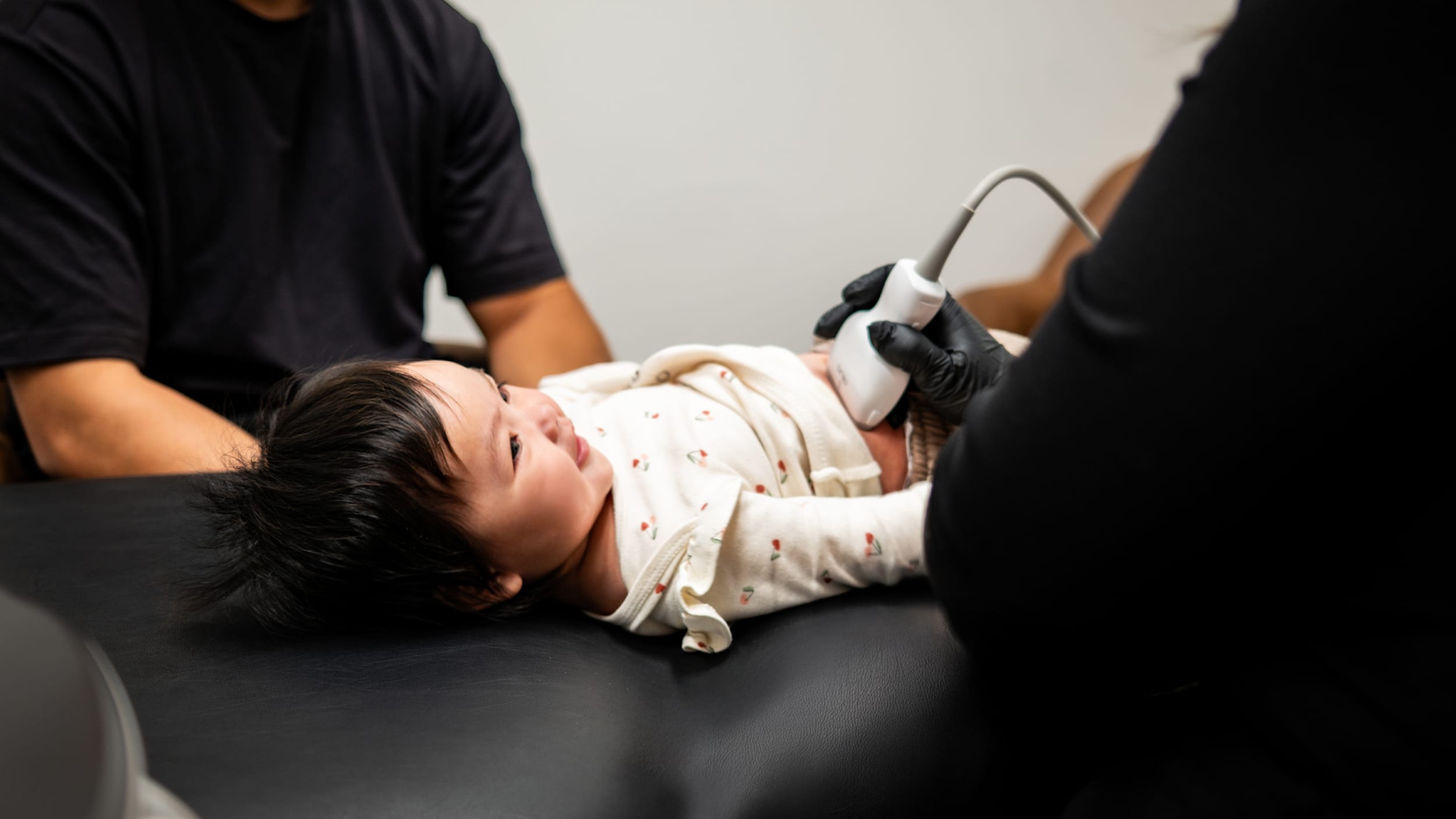
When it's time for the scan, your sonographer will introduce themselves to both you and your child. They'll get down to your child's level, explain what's going to happen in age-appropriate language, and let your child see the gel and the probe before anything starts. For very young children, sometimes a quick demonstration on a parent's arm helps take the mystery out of it.
You're welcome in the scan room throughout. For babies and toddlers, parents often hold the child or sit next to them on the bed. Older children sometimes prefer a parent close by but not directly involved. We follow your child's lead.
The scan itself involves warm gel applied to the area being imaged, and the sonographer moves a probe over the skin to capture pictures. There's no pain, no sharp instruments and nothing entering the body for routine paediatric scans.
How long it takes
Most paediatric ultrasounds take 15 to 30 minutes once we start scanning, although some specialised scans take longer. We allow extra time in our paediatric appointments because children sometimes need a moment, a break, or a snack partway through. We'd rather take an extra ten minutes than rush a child through an upsetting experience.
After the scan
Once the scan is complete, the gel is wiped off and your child can get back to whatever they'd rather be doing. There are no restrictions, no recovery time, and no follow-up needed from us. The report is sent electronically to your referring doctor, generally within one to two business days. They'll discuss the findings with you at your follow-up appointment.
If anything urgent is identified, we contact your child's referrer directly so the right next step happens promptly. You don't need to chase anything.
Frequently asked questions
Is ultrasound safe for children?
Diagnostic ultrasound has been used in children for many decades. It doesn't involve ionising radiation, which is one of the reasons it's often the first imaging choice for paediatric patients.
Can I stay with my child during the scan?
Yes. We encourage parents and carers to be in the scan room. For babies, you may hold your child during the scan. For older children, you can sit close by.
My child is very anxious about medical appointments. Can you help?
Please mention any anxiety when you book. We can talk through strategies, allow extra appointment time, and let your child take the lead on pace. If your child has a sensory sensitivity, neurodevelopmental difference or specific fears, sharing this in advance helps us plan a better experience.
Do I need a referral?
Yes, a current referral from a GP, specialist or eligible practitioner is required for all ultrasound scans.
Can I bring siblings?
Older siblings are welcome in the waiting area but not in the scan room, and we don't have supervision in the waiting area. If possible, please bring another adult to look after siblings, particularly for longer scans.
We're here to help
If your child has a referral and you'd like to book at our Jindalee or Springfield Central clinic, call us on (07) 3170 1352 or use the online booking form. We'll do everything we can to make the appointment a smooth one for your child and for you.