
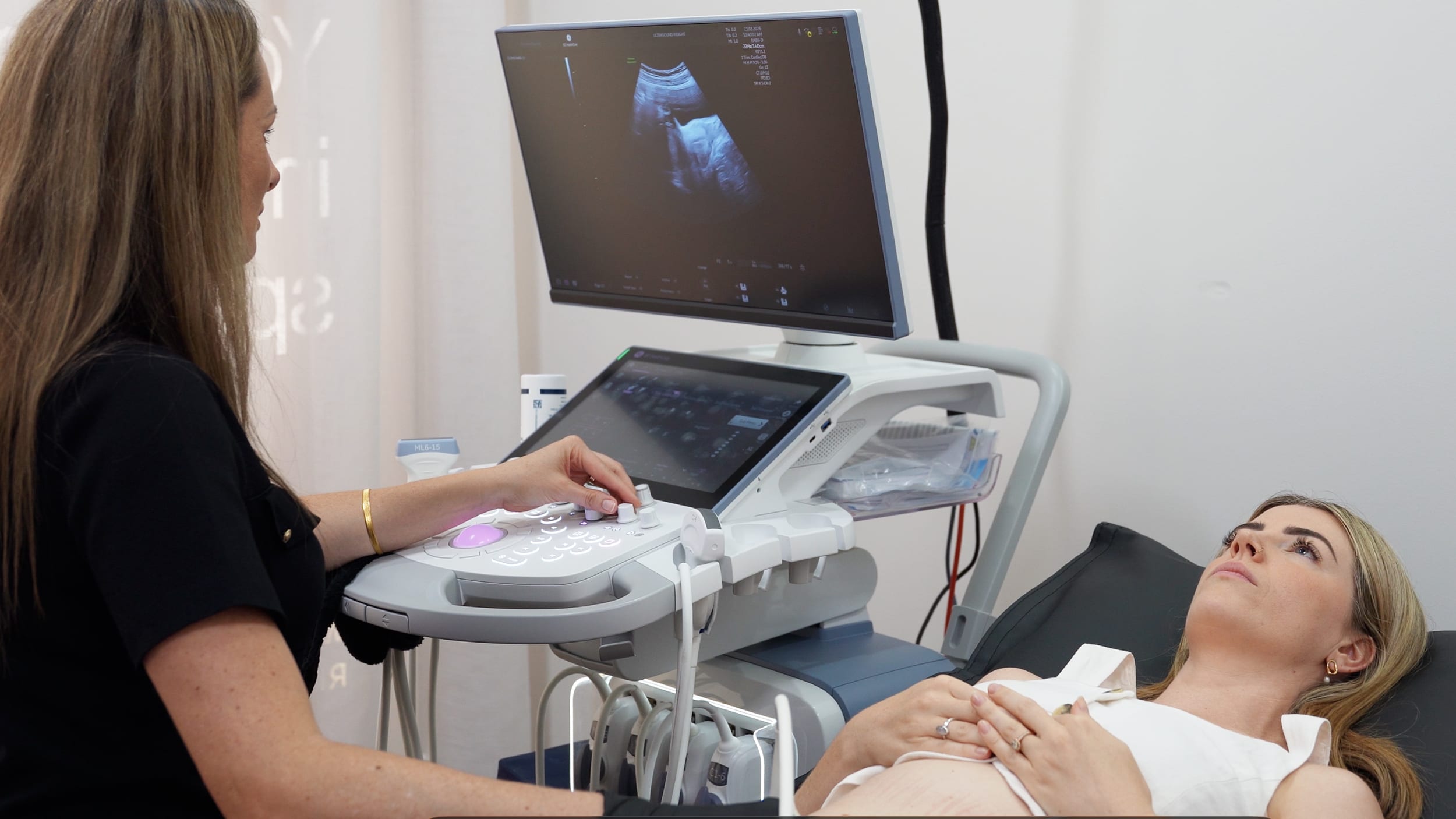

A pelvic ultrasound, explained simply
A pelvic ultrasound is a scan that uses sound waves to create images of the structures in your lower abdomen. For women, this usually means looking at the uterus, ovaries, fallopian tubes (when visible), endometrial lining and the area around them. There’s no radiation involved and the scan is non-invasive.
Your doctor might refer you for a pelvic ultrasound for many reasons. Some of the most common include investigating pelvic pain, abnormal bleeding, suspected fibroids or polyps, ovarian cysts, fertility concerns or simply as part of a broader health check. Whatever the reason, our role at our Jindalee clinic is to capture clear images and a detailed report so your doctor has the information they need to plan the next step.
How to prepare for your scan
Pelvic ultrasound preparation depends on the type of scan your doctor has requested. There are two approaches we use, and sometimes both are needed in the same appointment.
External pelvic ultrasound
For an external scan, the sonographer applies warm gel to your lower tummy and uses a transducer to image the pelvic organs through the abdominal wall. To get a clear view, your bladder needs to be full. We ask that you drink one litre of water in the hour before your appointment and avoid emptying your bladder until after the scan. A full bladder pushes the bowel out of the way and acts like a window for the sound waves.
Transvaginal (internal) pelvic ultrasound
A transvaginal scan involves a slim transducer being gently inserted into the vagina to provide more detailed images of the uterus, ovaries and surrounding structures. It’s typically recommended for patients aged 18 or over, and ideally performed between days 3 and 10 of your menstrual cycle when this is relevant to your scan request. For this part of the scan, your bladder should be empty, so you may be asked to use the bathroom partway through your appointment.
We understand that internal scans can feel a bit nerve wracking, particularly if it’s your first time. Our sonographers will explain everything before they begin and will only proceed once you’re comfortable. You can stop the scan at any point and you’re welcome to bring a support person with you.
What happens on the day
When you arrive at our Jindalee clinic, our reception team will check you in and confirm your details. We’ll show you to a private room where you’ll be asked to change as needed and lie down on the examination bed.
Your sonographer will introduce themselves, explain what they’re looking for and what you might feel during the scan. The external part is usually first, followed by the internal scan if it’s required. Most pelvic ultrasounds take around 30 minutes from start to finish, although some appointments are longer if multiple structures need careful assessment.
You’re welcome to ask questions throughout, but please understand that your sonographer can’t give you a diagnosis at the time of the scan. The full report goes to your referring doctor, who will discuss the findings with you. This isn’t about being unhelpful. It’s about making sure your results are interpreted in the context of your full medical picture.
Why our Jindalee clinic might suit you
Our Jindalee location is set up specifically for boutique imaging, which means quieter waiting areas, longer appointment slots and time to settle in if you need it. We know pelvic scans can be sensitive, and we’ve designed the experience around comfort and privacy.
If you have specific concerns about the scan, mention them when you book so we can plan accordingly.
After your scan
Once your scan is complete, you can usually return to your normal day straight away. There’s no recovery time and no restrictions on activity.
Your written report and images will be sent electronically to your referring doctor, generally within one to two business days. We recommend booking your follow up appointment with your doctor a few days after your scan so they have time to receive and review the report.
Frequently asked questions
Will the scan hurt?
External pelvic ultrasounds aren’t painful, although having a full bladder can feel uncomfortable. A transvaginal scan can feel a little unusual but shouldn’t be painful. Let your sonographer know straight away if anything feels wrong.
Can I have a pelvic ultrasound during my period?
Yes, you can. It’s safe and we’re used to it. If your scan is being done specifically to assess your endometrial lining, your doctor may ask you to time it to a particular phase of your cycle. Otherwise, your period is no reason to delay.
How accurate is pelvic ultrasound?
Ultrasound is a well-established imaging method for assessing the female pelvis. As with all medical imaging, it has strengths and limitations. Some conditions may need additional investigations such as MRI or laparoscopy, and your doctor will guide you on whether further testing is appropriate based on your symptoms and our report.
Do I need a referral?
Yes, a current referral from a GP, specialist or eligible allied health practitioner is required.
Can I bring a support person?
Of course. You’re welcome to bring a partner, friend or family member to your appointment.
Booking your pelvic ultrasound
If you have a referral and you’re ready to book, give us a call on (07) 3170 1352 or use the online booking form. Our team is here to make the process feel manageable from start to finish.